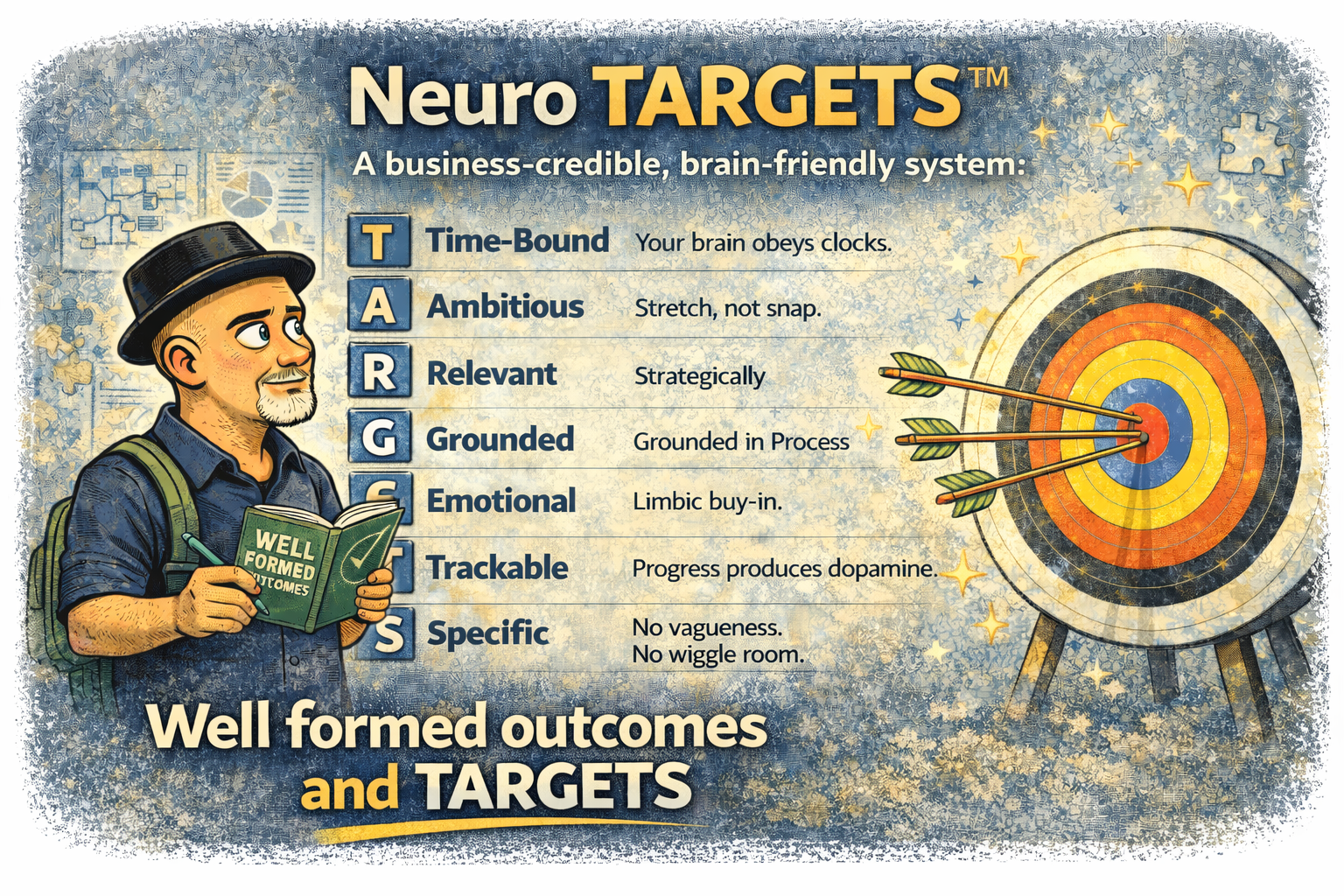
T.A.R.G.E.T.S™ for NeuroEntrepreneurs
Do your goals love disappearing the moment you write them down?
Like “I’ll get fit, fix my business model and sort out my inbox”… then suddenly it’s July and you’re just better at feeling guilty. I hear you. Busy brains sometimes get a bit sidetracked.
I have so many old goal lists that included things like:
- Get a six-pack (is that a priority right now?)
- Triple my turnover and income (errr, sounds good, but how?”
- Read 1 book per day (why not 5 books?)
- And, for reasons that escape me, learn a musical instrument and painting and writing and… oh dear, I have run out of space”
All in three months.
I colour-coded the list. I highlighted things. I bought a special pen to go with last weeks special pen. Then I did absolutely nothing of consequence.
By the end of the quarter I had:
- Zero abs
- Exactly the same bank balance. OK, it was a bit lower
- Lots of books that I started
- And a very expensive pen
My conclusion at the time was simple:
“Goals don’t work. I am broken. Pass the wine.”
Turns out I wasn’t broken.
My system was.
Or more accurately, I didn’t have one.
What a goal actually is
A nice definition that I read once is that a goal is any desired outcome that would not happen without some kind of intervention. I have to do something to get closer to the goal.
Left alone, your life will follow the path of least resistance: email, mild panic, snacks.
Formally, a goal is a desired future state plus a deliberate strategy of actions that make that future more likely.
In other words:
You need a destination and a route that your nervous system can tolerate.
Busy brains like ours usually have at least one of three problems:
- Vague destinations (“grow the business”)
- No route (hope as a strategy)
- A propensity for taking the pretty way around (lots of shiny new things to look at on the way)
So I built a system that mostly keeps my brain pointed in the same direction long enough to actually finish something:
T.A.R.G.E.T.S™ – The Busy-Brain Goal System.
Busy Brain Truth: if a goal is fuzzy, far away, or has no immediate feedback, your brain treats it like an “optional extra” (like creamed spinach and pumpkin instead of chips). Not because you’re lazy (although you may be). Because your wiring does not favour delayed rewards.
“Most goals fail for the same reason New Year’s resolutions fail: your future self wrote a cheque your nervous system won’t cash.”
Very short definition of T.A.R.G.E.T.S™
T.A.R.G.E.T.S™ bundles the essentials of good goal-setting into one checklist:
- Time-Bound
- Ambitious (but sane)
- Relevant (and Pareto-approved)
- Grounded in process (lead measures, not vibes)
- Emotionally meaningful
- Trackable (with a visible scoreboard)
- Specific (clear next actions)
Use it for your business, your team, or that personal project you keep pretending is “on the back burner” rather than “in the bin”.
Busy-brain rule: this is not a motivation framework. It has an element of emotional motivation but It’s a design framework.
T.A.R.G.E.T.S™ The elements
🎯 T — Time-Bound
A goal without a timeframe is just a daydream.
Your brain happily files “sometime this year” under “never”.
❌ “Increase customer retention.”
✔️ “Increase customer retention from 62% to 75% by 30 June.”
Busy Brain Tip: Add a time-box, not just a deadline.
Deadlines create pressure. Time-boxes create traction.
Example: “Work on retention Mon/Wed 10:00–11:00 (calendar-blocked).”
“A goal without a timeframe is just a daydream wearing a cheap nasty suit.”
⭐ A — Ambitious (but attainable)
Goals should stretch you… not snap you.
Too easy and you feel like a fraud.
Too hard and you feel like a failure.
❌ “Double revenue next week.”
✔️ “Increase weekly revenue by 15% in the next 8 weeks.”Busy Brain Tip: Make it ‘challenging + winnable’.
ADHD and busy brains thrive on visible progress: a series of micro-wins, not one impossible Everest.
If you can’t see a win inside 7 days, your dopamine system goes for a vape break and doesn’t come back until something exciting happens.
🧭 R — Relevant (and Pareto-approved)
If your goal doesn’t link to your values and the strategic thrusts of the business it will become the custard topping to a prawn cocktail: made sense to you and nobody else, colourful, briefly exciting, utterly useless.
Ask:
- Does this support the vision for the business?
- Does this support my values?
- Would anyone cry if this never happened?
Busy Brain Tip: Apply the 80/20 Goal Filter.
Pick one goal that makes other problems easier, cheaper, or irrelevant.
If you choose five “priorities”, you’ve chosen none. You’ve chosen anxiety. I know, I spent a lot of my life being anxious.
“If everything is important, your brain will treat everything as background noise and nothing will be important”
🖇️ G — Grounded in Process (lead measures)
This is where most humans fall apart, especially entrepreneurs.
You cannot “achieve” a goal or a strategic thrust or even a small job.
You reach targets by repeating (sometimes boring) behaviours behaviours that make success boringly inevitable.
Goal: “Sell 20 more consulting packages.”
Process (lead measures):
- 10 prospecting calls per week
- 3 proposals sent per week
- Daily follow-ups at 3:30pm
Bill Walsh had it right: “The score takes care of itself.”
Processes create certainty. Goals create pressure.
Busy brains cope much better with certainty.
Busy Brain Tip: Use “If-Then” scripts (implementation intentions).
- “If it’s 3:30pm, then I do follow-ups for 20 minutes.”
- “If I feel resistance, then I shrink the task to a 2-minute starter.”
“You cannot ‘achieve a goal’. You can only achieve the process that produces the goal.”
❤️ E — Emotionally meaningful
If a goal doesn’t emotionally matter to you, your brain treats it like spam.
Delete. Delete. Delete.
❌ “Lose 5kg.”
✔️ “Have the energy to play with my kids after work.”
Tie the goal to something you deeply care about. The big areas are Actualisation of self, Relationships, Certainty and Security, Autonomy and Freedom, Diversity and Variety, Equality and Fairness and lastly Status. There are no doubt many more, but get these right and its a great start.
Busy Brain Tip: Do an NLP ‘Well-Formed Outcome’ mini-check:
- What will you see/hear/feel when this is true?
- What will change day-to-day?
- Is it ecological (doesn’t break your life in the process. Is it good for the system)?
- Can you “future pace” it and feel it in your body?
“If a goal doesn’t emotionally matter to you, your brain treats it like spam.”
📊 T — Trackable (with feedback you can SEE)
The accountants will like this one. If you can’t measure it, you can’t manage it.
And if you can’t see movement, your dopamine system goes on strike.
Use both:
- Leading indicators: behaviours you control
- Lagging indicators: results you influence but don’t directly control
Example:
Leading: number of follow-up calls, number of demos booked
Lagging: new clients, monthly revenue
Tracking gives your brain constant feedback that you are moving, not just spinning.
Busy Brain Tip: Make tracking visual and slightly addictive with Dashboards
A simple 5 to 7 metric spreadsheet with visuals or a simple wall chart. A checklist. A streak. A weekly score out of 10.
You’re not “being childish”. You’re giving your brain the feedback loop it needs.
“Your brain doesn’t run on willpower. It runs on feedback.”
🧩 S — Specific (next actions, not poetry)
Specificity is clarity. Clarity is power. Ambiguity is where goals go to die.
❌ “Improve marketing.”
✔️ “Publish one educational LinkedIn post per day for 30 days.”
Specific goals reduce cognitive load.
That is a polite way of saying: “Your busy brain melts slower if it actually knows what to do next.”
Busy Brain Tip: Name the next action, not the entire project.
Not “build funnel”.
Yes: “Draft the offer headline and 3 bullets (25 minutes).”
“Clarity beats motivation. Clarity survives Monday.”
A more useful question
Old question:
“Why can’t I stick to my goals?”
New question:
“Which piece of T.A.R.G.E.T.S™ is missing from this goal?”
No date? Your brain cannot see it.
No process? Your brain cannot do it.
No emotion? Your brain does not care.
No tracking? Your brain cannot feel progress.
Not specific? Your brain can’t start.
You are not lazy.
You are just running woolly, un-designed goals on a high-voltage nervous system.
In closing
Back to my six-pack / triple-revenue / learn-Italian-hands quarter…
Today, that monstrosity would become:
- Time-Bound & Trackable: “Increase coaching revenue by 20% by 30 September, measured weekly.”
- Ambitious & Relevant: Tied directly to my business strategy, not my ego.
- Grounded in Process: X sales calls, Y content pieces, Z follow-ups each week.
- Emotionally Meaningful: “So I can reduce toxic work, control my time, and not die of stress before 60.”
- Specific: Written in plain language with clear behaviours I can actually tick off.
Of course that is still imperfect.
But infinitely more likely to survive beyond the stationery purchase.