Ever noticed how “Where do you see yourself in 5 years?” is one of the quickest ways to trigger either rage or mental dissociation?
Most busy-brain entrepreneurs don’t think in 5-year blocks; it’s more like 5-minute blocks.
We think in:
- “This week is hectic”
- “I really like doing this, so this MUST be important; let’s do more of it.”
- “Next month I’ll definitely be organised, I have just spent 4 hours setting up a new system to replace last month’s system.”
- “One day I’ll have systems, a team and a business.”
So let’s look at it a bit differently.
Just because you may have missed goals and targets in the past does not mean that setting them was a waste of time.
Three years.
Not someday.
Not “vision board nonsense.”
A 3-year vision your brain can actually latch onto, instead of filing it under Later (Never).
There is nothing magic about the number 3, but in my experience, it is a good “Goldilocks” number. Not too big, not too small.
The day I tried to vision-board my way to sanity
We have all been there, I am sure. I once sat in a personal strategy development workshop where someone handed out glitter, magazines and glue. I had a lot of fun.
“We’re going to create our 5-year vision boards,” said Maggie, the part-time serial entrepreneur, trying to wipe some glue off her loud and ill-fitting banana-coloured elastic camisole.
An hour later, we had:
- A castle, I thought I wanted to live in
- A very expensive car
- A six-pack (yes, it came up again)
- A strange-looking dog from page 7 of People Magazine, (it eats bears and can do crosswords, apparently).
- And one photo of a smiling multicultural “team” in matching shirts that looked suspiciously like a cult
What we did not have was:
- A clear picture of how the business actually worked. According to Maggie, that would manifest and happen. I am still waiting.
- Any idea what a normal Tuesday looks like (according to my research, business owners only work one day per week, and that’s on Tuesdays)?
- Clean hands
It felt cute and childlike.
It did not feel useful.
Because most “vision work” is too vague.
Busy brains need something different:
- Concrete
- Sensory
- Emotional
- Short enough to read before coffee kicks in
“Glitter doesn’t create direction. It creates decor.”
Your initial (completely understandable) misinterpretation
Most entrepreneurs secretly translate “vision” as:
- A paragraph for the website that sounds like a management consultant wrote it after three brandy and Cokes.
- A sentence about “being the leading international brand in Y” that means absolutely nothing to your nervous system.
- A fantasy reel with no date, no scale and no actual behaviour attached. Think grounded in process.
So we either:
- Avoid it altogether.
- Write something so generic it could belong to any company in any industry.
Neither of those helps your brain decide what to notice, what to build, or what to ignore.
The shift: a 3-year vision your brain can actually use
It’s a living description of:
“What my business and life look like when things are working the way they’re supposed to, at a scale I can actually handle.”
For smaller businesses, it could feel:
- Fun
- Slightly cheeky
- Creatively exciting
- Emotionally meaningful
And it should flow directly from your Winning Statements.
If Winning Statements are your scoreboard, your 3-year vision is the full-colour movie of what it feels like to play that game and win.
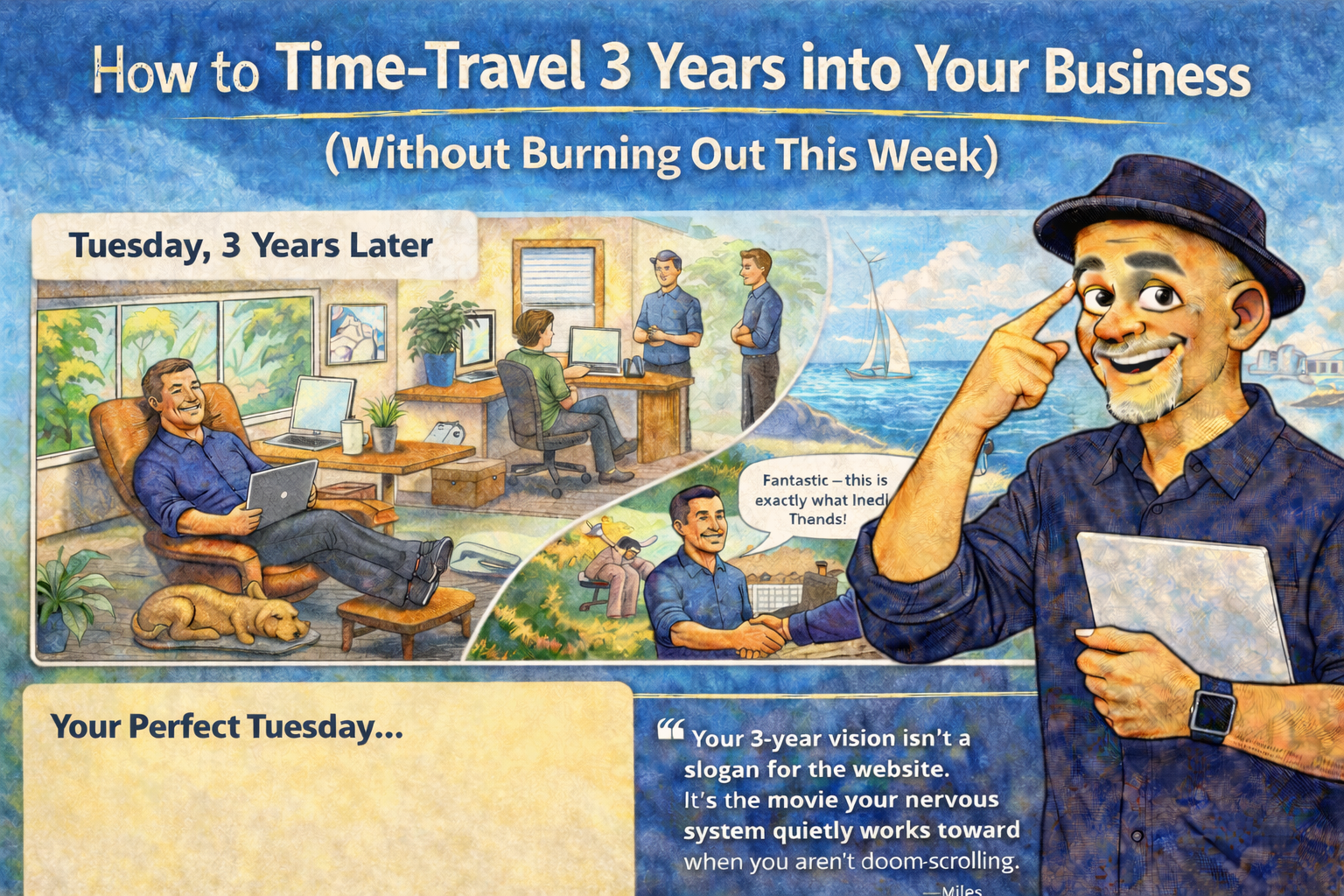
The perfect day: your time-travel exercise
Instead of asking, “What’s your 3-year strategy?”, try this:
“Describe a perfectly successful day in your business 3 years from now.”
Not the Instagram highlight-reel version.
The real one.
Write it in the present tense, as though it is happening now.
Prompts (steal these)
- How do you start your day?
○ Coffee? Dog? Gym? Quiet thinking? School run? - What does “arriving at work” look like?
○ Home office? Shared space? Actual office with actual humans? - What do you not do anymore?
○ Which tasks have been delegated, automated or put to sleep? - How many people are in your business, and what are they doing while you’re not rescuing them? Who are you delegating to? How are you delegating?
- What systems run smoothly without you checking them 19 times a day?
- What do customers say about your business when you’re not in the room?
- How do you spend free time without feeling guilty?
- What gives you that quiet “I actually built something decent” pride?
You are not writing poetry.
You are describing a day that would make future-you quietly proud and present-you slightly jealous.
“Busy brains don’t need a bigger dream. They need a clearer picture of a sane Tuesday.”
Why this works for busy brains
A few things your brain quietly does in the background:
- It pays attention to emotionally loaded pictures more than bullet lists. I have a lot of bullet lists that I ignore every day.
- It uses RAS attention filters (Reticular Activating System) to decide what to notice. When something becomes meaningful, you start spotting matching opportunities, problems and patterns.
- It responds better to:
- Present tense (“I start my day by…”)
- Sensory detail (what you see, hear, feel, do)
- Narrative (first this, then that)
So when you write your 3-year vision as a story of a perfect day, you are:
- Giving your nervous system a direction, not just a vague ambition
- Making it easier to say no to anything that doesn’t belong in that future. That’s a really difficult word to say sometimes.
- Turning “strategy” into something your brain can actually simulate and therefore move towards
You’re not manifesting according to some mystical and secret protocol.
You’re running a brain-appropriate planning protocol.
Simple strategy for busy brains: the 3-year vision STATEMENT script
That was YOUR vision. Let’s get a short version for your key stakeholders.
Here’s a simple fill-in structure you can use:
In 3 years,
[business name] is known by [ideal customers]
for [core difference/value you deliver]
because we consistently [key ways we operate/behave],
so that [impact for customers + benefits for the business/you].
Example
“In 3 years, NeuroEntrepreneurs is known by overwhelmed small-business owners and late-career pivots for practical, darkly funny, brain-friendly strategy tools, because we consistently teach simple frameworks, tell honest stories, and respect busy brains, so that clients build saner businesses, and I get to work with people who don’t bore me to death. We have served more than 1000 entrepreneurs”
Now layer in your Perfect Day description underneath that.
The anti-burnout upgrade (because the title promised)
Here’s where most vision exercises fail for busy-brain entrepreneurs:
They create an exciting future…
…and then you try to build it using the same exhausted operating system. Oops, that didn’t work!
So add constraints.
Not to limit your ambition.
To protect your nervous system.
Add these 3 “guardrails” to your 3-year vision
1. Non-negotiables (life first)
- Sleep window. I know you can also “survive” on 2 hours per night. You should not aim for surviving; you should aim for thriving. Just because you can do something does not mean you should. Sleep and rest enough. For most of us, more than 6 hours per night.
- Training/movement. You have to keep moving and exercising. More of this later in my series. For most of us a mix of weight training and cardio and mobility. No less than 30 minutes 3 times per week and ideally 60 minutes 5 times per week.
- Family/downtime. People are precious. Family, Church, Community. God built us to be social.
- One weekly empty block. Ha ha ha. I know, funny one, right?
2. Anti-goals from Mr Anti-Guru (what you refuse to become)
- “I don’t want a business that needs me online at 9 pm.”
- “I don’t want growth that increases chaos.” If you are like me, you won’t need to look for chaos; it will sniff you out.
- “I don’t want clients that require emotional hazmat suits.”
3. Capacity rules (how you avoid Tuesday death spirals)
- Max meetings per day
- Max projects at once
- Minimum recovery time after heavy work
- And measure and plan your energy cycles. More of this later.
“If your vision requires burnout to build it, it’s not a vision. It’s a hostage situation, and you should never negotiate with a terrorist.”
Bridge it back to this week (so it doesn’t become a lovely document you ignore)
Your 3-year vision is the movie.
Now we need the trailer.
The 80/20 move
Ask:
“What are the 1–3 recurring behaviours that future-me definitely does on a normal Tuesday?”
Examples:
- 30 minutes of pipeline work before the inbox. Eat that poor frog.
- A weekly team rhythm meeting with clear owners
- Two protected deep-work blocks
- One content system that runs without drama
Then do something radical:
Put the behaviour in your calendar as a default.
Busy-brain reality: if it isn’t scheduled, it’s fictional. And poor, predictable fiction is the worst.
A better question
Old, useless question:
“Where do you see yourself in 5 years?”
New, actually helpful question:
“If a normal Tuesday in your business, three years from now, felt like a win… what exactly would be happening?”
One triggers an undercooked waffle.
The other triggers design.
Three short quotes you can steal
- “Your 3-year vision isn’t a slogan for the website. It’s the movie your nervous system quietly works towards when you aren’t doom-scrolling.”
- “If you can’t describe a single perfect day in your future business, your calendar will happily fill itself with other people’s priorities.”
- “Busy brains don’t need a bigger dream. They need a clearer picture of what a sane, successful Tuesday actually looks like.”
And the glitter?
Remember the glitter-covered vision boards?
They gave us decor, not direction.
Pretty, but cognitively useless, like so many self-help courses and books.
A real Neuro 3-Year Vision is the opposite:
- Written in your own voice
- Anchored in a specific timeframe
- Connected to your Winning Statements
- Detailed enough that your brain knows what to look for
- Emotionally enough that you actually care
Three years from now, you will arrive somewhere.
Might as well decide what the place looks like before you get there.
If you’d like help turning your 3-year fog into a clear, busy-brain-friendly vision and strategy, that’s exactly what my NeuroEntrepreneurs™ workbooks and coaching are designed to do.
One perfect future Tuesday at a time.