Ever had one of those days where you’re exhausted, your inbox is bleeding, your calendar looks like something your puppy brought up after eating the Christmas cake?
…and you still can’t answer a very simple question like “what do you want for dinner?” or:
“Am I actually winning this game, or just very busy?”
If you’re a busy-brain entrepreneur, this question can haunt you, or it can totally evade you.
Because if you don’t define “winning,” your brain will, and it won’t be pretty. It will be messy.
And your brain can be creative. Not always strategic.
That’s why you need Winning Statements.
Not another vision board.
Not another KPI spreadsheet of doom.
A simple, brain-friendly way to decide what “winning” actually means in your business.
The day I realised I had 37 KPIs and no idea
I’m standing in front of a whiteboard with a group of business owners. Some of them have come from corporate backgrounds. You can tell which ones they are; they have the best acronyms.
The board is full.
“Right,” I say. “Let’s list your success measures.”
They go wild.
Revenue. Profit. Leads. Website traffic. Staff happiness. Instagram followers. Email list. Client retention. NPS.
CSAT. EBITDA. ROAS. WTF. I think I understood the last one.
I ask:
“Cool. Which are the top three that will give you the best ‘winning’ feeling?”
Or:
“Which are strategic thrusts that inch me further towards my TARGETS?”
Silence.
Blink. Shuffle.
The odd nervous titter.
Because here’s the uncomfortable truth:
Most entrepreneurs are chasing “success” without ever defining what winning actually looks like.
So they copy:
- Corporate dashboards
- Random “7 metrics every CEO must track” posts
- Whatever their clever friend mentioned at the gym
And then they wonder why they feel like failures while working 70-hour weeks.
“A business without a clear definition of winning is just a very expensive way to stay anxious.”
Your initial (completely understandable) mistake
Most people secretly define winning as one of three things:
- “More money.”
- “More growth.”
- “More stuff.” (products, followers, projects, tabs open in Chrome, etc.)
None of those is wrong.
They’re just vague.
“More” is not a strategy. It’s a plea.
Busy brains are especially vulnerable here. We are world-class at:
- Starting new initiatives
- Saying yes to shiny ideas
- Convincing ourselves it’s all “strategic”
Meanwhile, the business is sending quiet little smoke signals:
- Key clients are wobbling
- The team is confused
- Cash flow is patchy
- You’re measuring everything and focusing on nothing
You don’t have a strategy.
You have a collection of efforts.
“If everything is important, your brain will treat everything as background noise.”
The shift: Winning Statements, not random activity
Enter Winning Statements.
A Winning Statement answers one question:
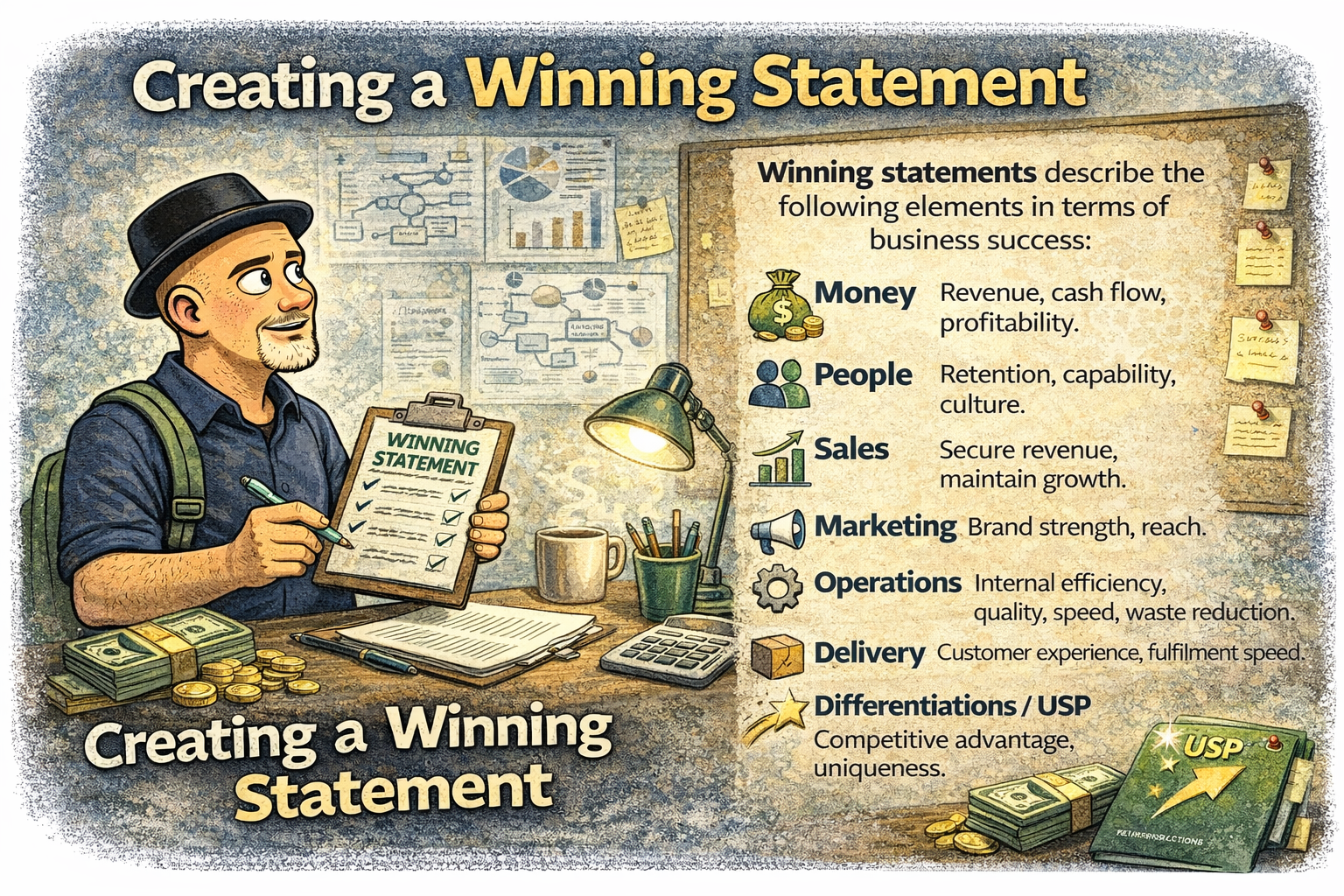
“What does winning actually mean for this business and its departments over the next 12–36 months?”
Across very real, very practical categories:
Tip: According to Verne Harnish in Scaling Up (and his foundational Mastering the Rockefeller Habits), organisations should focus on three to five key capabilities or strategic thrusts.
- Money movements and cash flow
- People
- Sales
- Marketing
- Operations
- Delivery
- Differentiation / USP
These are the most common and can be updated and customised.
Think of it as a strategic scoreboard that your busy brain can still understand at 7am on a Tuesday.
Why this works for busy brains (quick science, zero fluff)
- Ambiguity is expensive: unclear targets spike cognitive load, decision fatigue and “avoidance by admin.”
- Your brain is present-biased: it prefers what’s loud, urgent and immediate (hello, inbox) over what’s important.
- You need a scoreboard: visible feedback creates micro-wins, which keeps dopamine online.
“If you don’t define winning, your nervous system will. And it usually votes for ‘survive the week’, not ‘build something great.’”
The Winning Statements (with busy-brain translation)
1) Money: the oxygen
Why it matters: revenue, cash flow, profitability, stability.
Not just “turnover.” Not just “top line.”
Track it with:
- Revenue (monthly)
- Net profit %
- Cash flow (positive/negative)
- Gross margin
Winning sounds like:
“We consistently generate $X per month at Y% net profit with stable, positive cash flow. I have $20,000 in the bank, which covers two months of fixed overheads.”
Busy Brain Tip: pick one primary money metric to obsess over weekly.
Revenue is vanity, profit is sanity, cash is king. Increasing the bank account balance whilst paying your accounts is a great place to start.
2)People: the nervous system
Why it matters: skills, morale, capability, culture, retention.
Track it with:
- Retention rate
- Capacity/utilisation
- Training or development hours
- “Energy score” (simple 1–10 pulse)
Winning sounds like:
“We have a stable core team, low staff turnover, and people who actually want to be here.”
Miles Quote Box
“Culture is what happens when you’re not in the room firefighting.”
3) Sales: the blood flow
Why it matters: the ability to close deals, secure revenue, and maintain growth.
Track it with:
- Sales volume
- Conversion rate
- Average deal value
- Sales cycle time
Winning sounds like:
“We have a simple, repeatable sales process that reliably turns qualified leads into profitable clients.”
Busy Brain Tip: build lead measures (the actions), not heroic outcomes.
If every sale feels like an improvised rescue mission, that’s theatre, not strategy.
4) Marketing: the signal
Why it matters: visibility, reach, trust, awareness.
Track it with:
- Qualified leads (not just ‘reach’)
- Campaign ROI
- Email list growth
- Content rhythm (output you can control)
Winning sounds like:
“The right people know we exist, know what we stand for, and raise their hands regularly.”
Busy Brain Tip: Likes are nice. Leads are better.
Also, your marketing doesn’t need to be perfect. It needs to be consistent enough to be remembered.
5) Operations: the guts
Why it matters: internal efficiency, quality, speed, waste reduction.
Track it with:
- Turnaround time
- Error/rework rate/wastage
- Delivery bottlenecks
- Cost-to-serve
Winning sounds like:
“Work flows through the business cleanly without you firefighting every second email.”
Busy Brain Tip: If you feel like the human duct tape holding everything together, operations are not winning. Processes must be in place.
6) Delivery: the promise
Why it matters: reliability, customer experience, and fulfilment speed.
Track it with:
- On-time delivery
- Customer satisfaction (CSAT/reviews)
- Referrals
- Repeat business
- Indirectly with customer retention
Winning sounds like:
“We deliver what we promised, when we promised, and people are happy to tell others.”
Busy Brain Tip: Great marketing without delivery is just professionally coordinated disappointment.
7) Differentiation / USP: the “why you”
Why it matters: competitive advantage, uniqueness, and why clients choose you.
Track it with:
- Repeat business
- Win-loss reasons (“we chose you because…”). You have to ask this question!
- Clarity test: Can someone explain your offer in one sentence?
Winning sounds like:
“We are known for X, in the Y market, and people can explain that in one sentence.”
Busy Brain Tip: If your own team can’t answer “why would a smart customer pick us?” without rambling, your USP is theoretical. Many of mine started this way.
“If your differentiation needs a TED Talk, it isn’t differentiation.”
Simple strategy for busy brains: the one-page Winning Statement
Under each of the 7 business areas, answer two questions:
- What does winning look like here in 12–36 months?
One sentence. No poetry. No fluff. - How will we know?
Two to three numbers or signals you can track.
That’s it.
“Does this move one of my Winning Statements forward?”
If not, it’s content. Not a strategy.
Busy-brain add-on: the 80/20 veto rule
Pick one category for the next 90 days that will unlock everything else.
Then enforce this rule:
No new projects unless they move that category’s numbers.
It sounds strict.
It is.
So is burnout.
“You don’t need more goals. You need a better ‘no’.”
A better question
Original unhelpful question:
“How do I grow my business?”
Reframed, useful question:
“What does winning look like in Money, People, Sales, Marketing, Operations, Delivery, and Differentiation over the next three years, and what am I actually tracking weekly?”
One sends you into a spiral of vague anxiety and YouTube.
The other gives you a scoreboard.
And the whiteboard room?
We erased most of it.
Kept seven boxes.
The energy in the room changed.
Less panic. More focus.
That’s the job of a Winning Statement.
Not to impress a board.
Because once you know what winning looks like, you can do the most rebellious thing a busy-brain entrepreneur can do:
Start saying “no.”
If you want help turning your chaos into a clear set of Winning Statements, that’s exactly what my NeuroEntrepreneurs™ strategy workbooks and coaching are built for. One brain-friendly page at a time.