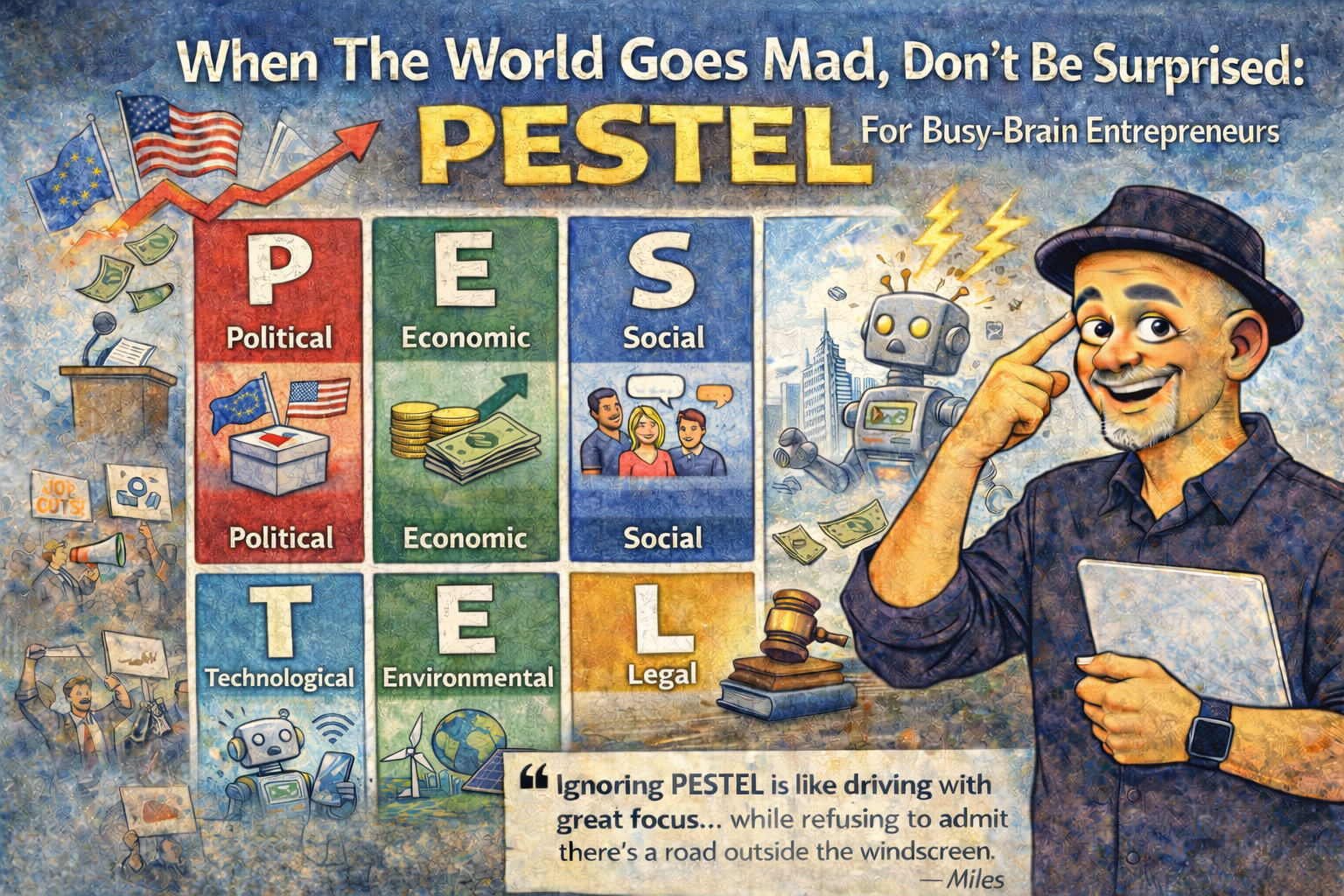
Have you noticed how some business owners act genuinely shocked every time the world does something… predictably ridiculous?
Elections happen, and nowadays the results are rarely final.
Interest rates go up, down, or stay the same.
AI “suddenly” exists and may or may not be planning to take over. A new law appears, and everyone pretends they were never warned.
Those are sort of known unknowns. Then we have “Black Swan” events like 2020.
Meanwhile, your nervous system is already running at 120% just trying to open your inbox.
This is where PESTEL comes in.
Not as a corporate buzzword. It’s not even a proper word; feel free to change the letters around.
It is a simple external radar system for busy-brain entrepreneurs who would prefer not to be blindsided every six months.
The day I realised the world was also in my business plan
For years, I secretly believed that “macro environment” was just something MBAs said when they wanted to sound clever. Now everyone has an MBA, even me. None of us sound clever anymore.
My strategy was simple:
- Focus on my own chaos
- Assume the rest of the world would behave itself
- Blame “the economy” when it didn’t
Then, in 2007, with the “coming of the Great Liquidator” things changed, and eventually my dream company closed its doors.
- New regulations had been put in place for the fitness industry.
- The first mutterings of a financial crisis were being heard. It’s so far away it won’t influence me!
- A political decision in a city I’ve never visited suddenly affected my clients’ budgets.
Apparently, the world did not get the memo that it must remain stable while I figure myself out.
“Ignoring PESTEL is like driving with great focus while refusing to see the road outside. Crash. Boom”
Your initial (totally understandable) misinterpretation
Most small-business owners and solo entrepreneurs quietly think:
“PESTEL is for big companies. Corporates with strategy departments, golf shirts, private parking and people called Sir”
So we:
- Treat politics, economics, social shifts and tech as background noise and great entertainment. Chewing gum for the brain.
- Only pay attention when something explodes in our faces. Have you noticed that happening?
- React emotionally instead of preparing strategically for those “might affect us” moments
Busy brains are extra vulnerable here, because the external world becomes just another overwhelming firehose of “too much information.” It’s much safer in a quiet padded room where we can just shut out the outside world.
So we do what we do best.
We avoid it.
The shift: PESTEL as your external brain
Here’s the grown-up bit:
PESTEL is just a structured sequence of considerations and a way of asking:
“What is happening out there in the real world that will hurt me, help me, smack me, starve me, or save me in here?”
PESTEL stands for:
- Political
- Economic
- Social
- Technological
- Environmental
- Legal
For busy brains, it’s a 15–30 minute thinking sprint that gives shape to chaos. It is also fun because it taps into your creativity. No right and wrong answers like your tax submissions.
Think of it like this:
- Your inbox is “internal chaos.”
- PESTEL is “external chaos.”
If you don’t scan the outside world, you’ll spend the next quarter reacting to it like a confused meerkat.
“Strategy isn’t knowing everything. It’s knowing which three things outside your business deserve your attention this quarter.”
Quick & Dirty PESTEL for NeuroEntrepreneurs
Busy-brain rule: you’re not trying to predict the future.
You’re trying to stop being surprised by the obvious.
For each letter: write one threat, one opportunity, and one action.
🏛️ P — Political
Government, power shifts (think tenders), policy, rules, and the occasional disputed election result.
Think: tax changes, labour laws, procurement decisions, local infrastructure chaos, trade rules.
Ask:
- “Which decisions up there might mess with me down here?”
- “Where does government spending or non-spending hit my customers’ wallets?”
Action: One threat, one opportunity, one next step.
💱 E — Economic
Inflation, interest rates, exchange rates, and the general “mood” of money and those who (think they may) have it.
Think: rising living costs, petrol price, oil shock, clients and government delaying projects, your supplier and input prices changing.
Ask:
- “If this trend continues for 12 months, what happens to my margins?”
- “Do I need to adjust pricing, offers, or payment terms?”
Action: One risk, one planned buffer move (e.g. smaller starter offer, price ladder, shorter payment terms).
👥 S — Social
Humans are wired and weird together.
Demographics, lifestyle trends, culture, education, attitudes.
Think: 4IR, repurposing of human workers, remote work norms, wellness trends, trust fatigue, health and fitness awareness, need for convenience, demand for home delivery and home service, attention span collapse, (OK, only me then?) and “cancel culture” and “authenticity” shocks (I’m not buying from brands that feel fake).
Ask:
- “How are my customers’ beliefs and habits shifting?”
- “Is my offer still emotionally relevant to how they see themselves?”
Action: One trend to lean into (instead of fighting it like a stubborn three-legged goat which thinks it can fly).
💡 T — Technological
The part where Skynet quietly joins your industry. (OK, too late. It is already monitoring this post. I am screwed. Say something nice about computers, Miles.)
Innovation, automation, AI, platforms, software, drone usage, robotics.
Ask:
- “What tech could remove friction or cost in my business?”
- “What tech could make me obsolete if I ignore it?”
Action: One tool to test + one risk to watch.
“Tech doesn’t replace people automatically. It replaces people who refuse to learn to work with it. It has always been the case”
🌱 E — Environmental
Planet, sustainability, climate, weather, and the guilt industry.
Think: energy costs, supply chain stability, customer expectations about ‘green’ behaviour, and regulations creeping in. Think about wastage and what waste you generate, and what you kick down the road and make someone else’s problem. Think about how many people are doing the same thing.
Ask:
- “Is there anything about how we operate that will look embarrassing in 3 years?”
- “Are clients starting to care about sustainability in my space?”
Action: One small improvement you can make without becoming a full-time eco-evangelist.
Admission
I will own the fact that I feel quite passionate about the world we have been given to live in. I certainly don’t do enough to help the environment. There is one certainty: Elon is not sending us all to Mars. Let’s try to tidy up the planet that we have.
⚖️ L — Legal
Laws, licences, compliance, contracts. Very fluid, very political. Always shifting.
Think: POPIA/GDPR, consumer laws, sector rules, contracts you downloaded from the internet at 2 am.
Ask:
- “Which regulations actually apply to me?”
- “Where am I currently winging it and hoping nobody checks?”
Action: One legal loose end you will sort this quarter.
“The law does not care that you’re creative, neurodivergent or ‘bad with admin’. It just cares that you complied.”
Simple Strategy for Busy Brains: the 30-minute PESTEL sprint
Here’s how to make this usable and not soul-destroying.
- Set a 30-minute timer.
No more. Miracle if you even do 20. - Draw a one-page PESTEL grid.
Six boxes. One for each letter. - For each box, list only 2–3 factors that matter to your business right now.
Not everything in the news.
Just what actually hits your clients, costs, or operations. - Next to each factor, label it:
- T = Threat
- O = Opportunity
- ? = Tends and or Uncertainty
- Circle three items total and write one action next to each.
Those are your external strategy factors to carry through to the rest of your strategy design.
The 80/20 rule (because busy brains)
You’re allowed to notice lots of things.
You’re only allowed to act on three.
That’s the difference between strategy and doom-scrolling.
“Strategy is not knowing everything. It’s choosing what deserves your attention.”
Reframing the question
Old question:
“What’s happening in the Real World?”
New question:
“Which external shifts will hurt or help my specific business if I ignore them for 12 months?”
One leads to doom-scrolling.
The other leads to decisions.
Closing the loop
The world will continue being:
- Politically erratic (and, it would seem, erotic)
- Economically moody
- Socially dramatic
- Technologically hyperactive and become faster
- Environmentally stressed and depressed, with a lack of enthusiasm to change things
- Legally tedious
PESTEL doesn’t fix any of that.
What it does is stop you from being surprised by quite so much of it.
For a busy-brain entrepreneur, that is gold
You are already juggling your internal chaos.
PESTEL simply says:
“Let’s take 30 minutes to check what the outside world is doing before it hits you in the face.”
If you want a printable, brain-friendly Neuro PESTEL worksheet (boxes, prompts, space for actual scribbling), that’s part of the NeuroEntrepreneurs toolkit I use with clients.
One page. Six boxes. Slightly dark humour.