Why smart businesses still drift
There is a particular kind of organisational suffering that looks impressive from a distance.
The founder has ideas. The team has workshops. Somebody has made a colour-coded board. There are initiatives, workstreams, transformation pillars, priorities, sub-priorities, and a heroic person updating a spreadsheet as if civilisation depends on conditional formatting.
And yet the business is still drifting.
Not because the people are stupid.
Not because they do not care.
Not because they lack effort.
Usually, it is because they have confused movement with direction.
That is the rude little truth nobody frames nicely in the boardroom. Smart businesses do not usually drift because they have too few ideas. They drift because they have too many, too few disciplined choices, and no clean way of turning intention into consistent action.
This is not only a founder problem. I see it in owner-managed firms, SMEs, universities, not-for-profits, leadership teams, and businesses with enough meetings to qualify as a minor religion. Everyone is busy. Everyone is committed. Everyone is also pulling in slightly different directions and calling it progress.
That is where drift begins.
Drift rarely arrives wearing a cape. It shows up in more ordinary clothing. It looks like too many priorities. It looks like new initiatives are being added without old ones being killed. It looks like leaders are saying yes to everything because everything sounds vaguely important. It looks like teams are unable to distinguish the main priority from the latest interruption. It looks like “alignment” is being spoken about as though it were a mystical woodland creature that appears if enough adults nod at a flipchart.
It also looks expensive.
Because strategic drift is not a philosophical problem. It is a cost problem. It wastes attention. It creates duplicated effort. It muddies ownership. It burns energy. It fills calendars with noise. It corrodes morale. People can cope with hard work far better than they can cope with pointless work. A difficult priority is tiring. A shapeless one is soul poison.
The trouble gets worse when clever people are involved.
Intelligent teams are especially vulnerable because they can generate options faster than they can kill them. Possibility breeds complexity. Complexity breeds ambiguity. Ambiguity lets too many things remain open. Soon, the business becomes a buffet of half-made decisions and unfinished commitments. Strategy turns into a beautifully worded conversation about what might matter, rather than a disciplined decision about what actually will.
And this is where many businesses get trapped.
They mistake strategy for aspiration.
They mistake planning for clarity.
They mistake busyness for traction.
They mistake discussion for decision.
In other words, they build what I call strategy theatre.
Looks lovely. Sounds serious. Dies by Thursday.
The real issue is usually simpler and less glamorous.
First, there is priority inflation. Everything becomes strategic. Every project has a good story. Every stakeholder wants a seat at the table. Soon the strategy is no longer a direction. It is a hostage note written by committee.
Second, there is a translation failure. Senior leaders often think they have communicated the strategy because they announced it. That is adorable. Strategy is not real until it has been translated into choices, roles, trade-offs, time allocation, ownership, and review. Until then, it is decorative language wearing business shoes.
Third, there is attention fragmentation. If leadership attention is scattered, the organisation becomes scattered. If everything is urgent, the business starts behaving like a Labrador in a fireworks factory.
Fourth, there is complexity without decision rules. People are told what matters, but not how to choose when new requests arrive. So every week becomes a fresh debate. The team keeps re-deciding the same things because nobody built a usable filter.
And fifth, there is the oldest problem of all: nobody wants to kill anything. Businesses love addition. Addition feels optimistic. Subtraction feels cruel. But strategy is not just deciding what to do. It is deciding what not to do, what to delay, what to delegate, and what to bury quietly behind the shed.
So what actually helps?
Choose fewer priorities. Few enough to feel uncomfortable.
Make them legible. People should be able to explain what matters in plain English without sounding like they swallowed a consulting brochure.
Translate priorities into ownership. Who owns what? By when? Using which rules? Reviewed how often?
Build learning into the system. Strategy should not be rigid, but it must be disciplined. Learn, adjust, refine. Do not worship the original plan like a sacred relic. Also, do not fling it into a ditch and call that agility.
And protect attention. Because if your people are constantly interrupted, context-switched, and dragged into every passing urgency, the strategy will be eaten alive by noise.
This is where my work fits.
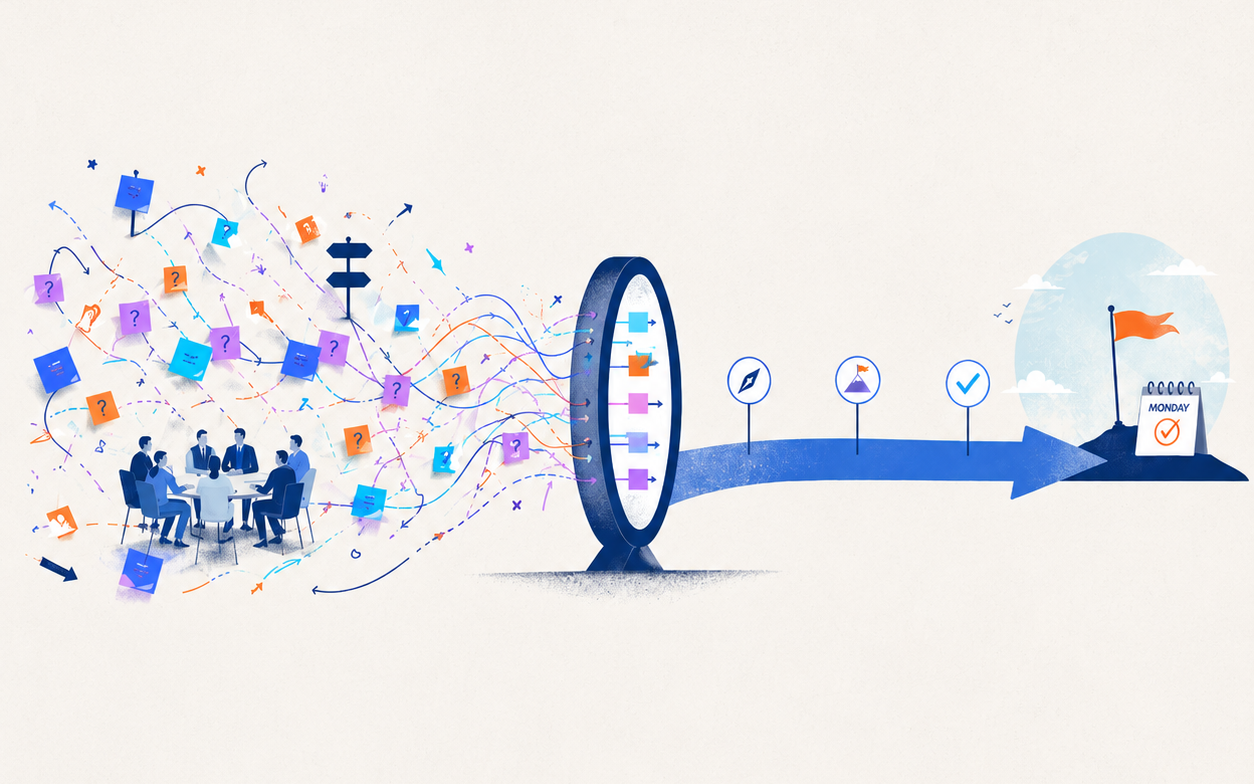
I help leaders and teams find the pattern inside the mess. We identify what noise is and what the signal is. We uncover what is strategically important and what is merely loud. We expose the trade-offs people are avoiding. We simplify the picture, reduce the chaos tax, and build decision rules that human beings can actually use.
Not motivational wallpaper.
Not another clever deck.
Not a prettier diagnosis of dysfunction.
Usable traction.
Because the goal is not to sound strategic. The goal is to create a business that knows what matters, chooses properly, and keeps moving in the same direction long enough for the effort to count.
Smart businesses do not drift for lack of brains.
They drift for lack of disciplined clarity.
And clarity, sadly, does not descend from heaven because somebody booked a venue and ordered muffins.
It has to be built.