Ever had that sinking feeling that you are working harder than a Buckingham Palace PR officer?
You say all the right things, manage the processes, but that product does not seem to behave itself in the marketplace.
In many cases, you lose your customers and income to a competitor with all the charisma of last night’s Big Mac left on your dashboard. It’s so unfair.
That is usually not about talent and skills.
In fact, a friend of mine always used to say, “He who markets hardest, wins,” when I used to complain about losing out to a clearly inferior company!
It is about Key Success Factors.
In other words:
Are you actually good at the things this game rewards? (Whatever “This Game” actually is)
or just the things you personally enjoy doing?
This piece follows the earlier parts of Simple Strategies for Busy Brains.
First, you defined a real outcome with T.A.R.G.E.T.S™.
Then you defined what winning means with Winning Statements.
Then you built a 3-year vision and scanned the outside world with PESTEL.
Now we get more specific:
What are the few capabilities your industry quietly insists on before it takes you seriously?
The day I realised I was winning the wrong game
Years ago, I was convinced I was doing all the right things.
Clients liked our business, and we were making money.
We delivered a good product, and our prices were low.
I had great staff, even better training programmes and used to give people a free water bottle for spending a month’s salary with us.
Then I began haemorrhaging staff and clients in an unpleasantly rapid manner. A new competitor had arrived. I thought that they were boring and overly corporate. My staff and members felt otherwise.
Naturally, I blamed the stupid clients, the uneducated market, the short-sighted staff and the dog that lived next door. Especially the dog that lived next door. Bad dog.
Then I looked more carefully.
They were not better at everything.
But…they were better at the few things that mattered most in that industry at that moment for the size of business that we had become.
What worked last year when we were smaller is no longer working.
They delegated more effectively. They had a corporate structure.
They implemented more consistently. They have rules and those horrible “Brand Standards”.
They followed through more reliably. They paid their staff on time.
They communicated in a boring but dependable rhythm.
We didn’t.
And for the previous 10 years, we didn’t have to.
But we had grown, and the game had changed.
And we hadn’t.
“KSFs are the unwritten exam rules of your industry. You don’t have to like them. You just have to know what’s going to be on the paper.”
What KSFs actually are
Key Success Factors are the essential activities, capabilities, and strengths your business must get right to compete effectively in a particular market. They also change as you grow or shrink.
They answer three useful questions:
- What basics must be in place just to participate?
- How does this industry usually operate?
- What makes us worth choosing over similar alternatives?
Most people secretly think success comes from hard work and being good at what they do.
That is only partly true.
Because you can be:
- brilliant at ideas in an industry that rewards flawless execution
- excellent with people in a sector that mostly cares about price and speed
- creatively gifted in a market ruled by compliance and reliability
If you do not know your industry’s KSFs, you over-invest in the wrong strengths, under-develop the boring essentials, and feel emotionally offended instead of strategically informed.
The KSF Triad for busy brains
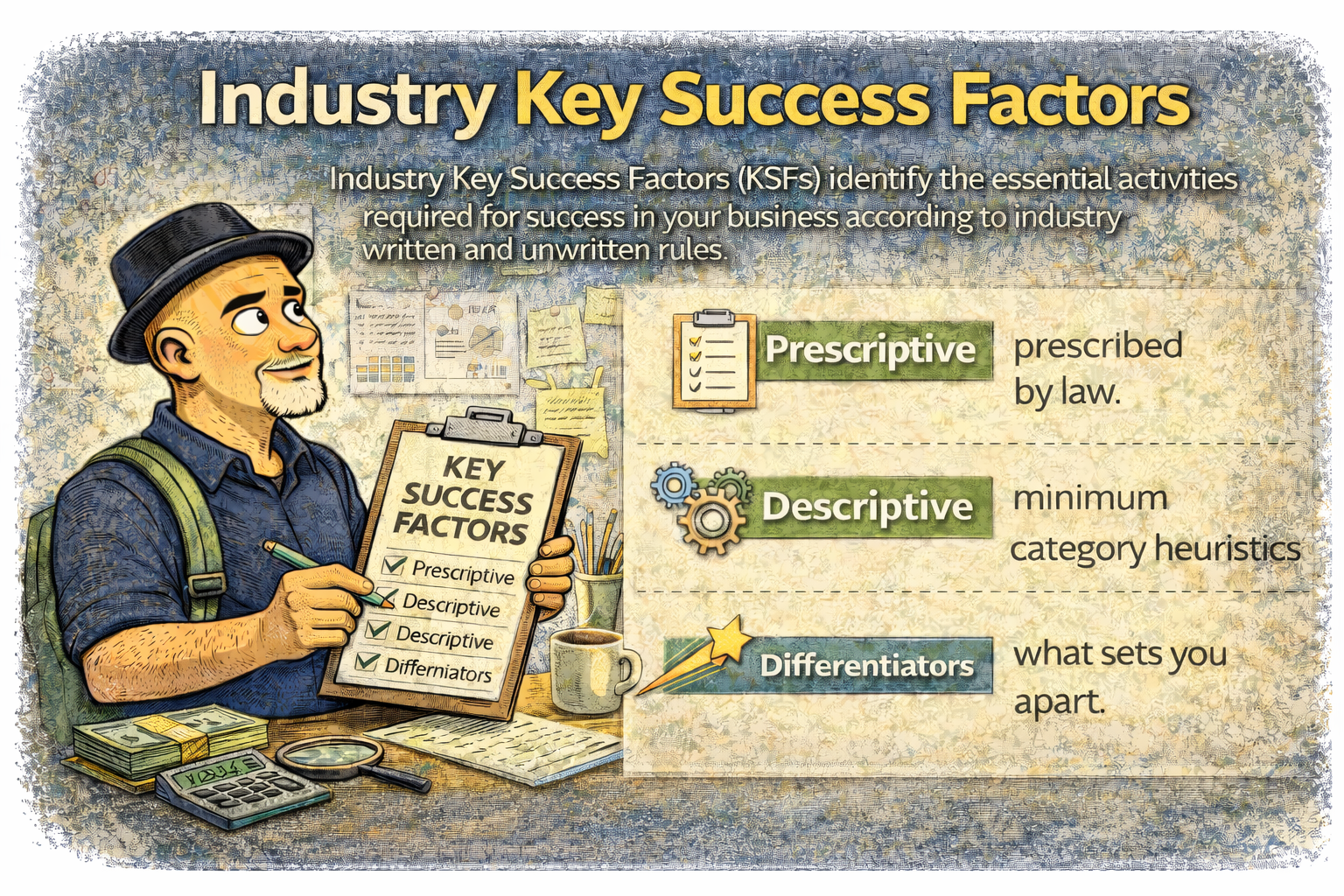
Group KSFs into three buckets.
1. Prescriptive: the non-negotiables
These are the basics every serious business in your space must get right.
Think:
legal compliance, minimum standards, safety, cash flow, core sales process, and basic digital competence.
These do not win you prizes.
They stop you from being shut down, sued, or quietly avoided.
2. Descriptive: the industry norms
These describe how the industry typically operates and what counts as “being in the category.”
This is where you ask awkward questions such as:
Does a taxi company need to own taxis?
Does a hotel company need hotels?
Does a gym need expensive treadmills and changing rooms?
Sometimes the answer is yes.
Sometimes the answer is “not anymore.”
This is where innovation often hides.
By critically questioning each of these criteria, you can begin challenging assumptions and prepare for the next category…
3. Differentiators: why anyone should pick you
These are the factors that make you worth choosing.
Better client experience.
Distinctive expertise.
A clearer niche.
A smarter process.
Stronger positioning.
Differentiators only count if customers value them.
If you can sustain them over a period of time and protect them, then these can become SCAs (sustainable competitive advantages) as opposed to TCAs (transient competitive advantages).
“Prescriptive KSFs stop you dying. Descriptive KSFs show how the industry is living. Differentiator KSFs decide if you’re worth noticing.”
The KSF Scoring Sprint
Give it 30 minutes.
Step 1: List 8 to 12 KSFs
Spread them across the three buckets.
Examples:
compliance, response time, implementation quality, technical expertise, pricing model, customer experience, brand trust, speed and reliability.
Step 2: Weight each factor from 1 to 5
Ask:
How important is this in this industry?
- 5 = critical
- 4 = very important
- 3 = useful
- 2 = nice-to-have
- 1 = smells like last year’s Christmas pudding
Step 3: Rate yourself from 1 to 5
How good are you at it right now?
- 5 = excellent
- 4 = strong
- 3 = average
- 2 = weak
- 1 = embarrassing
Then multiply:
Weight × Rating = Your Score
Now you can see where you are strong, where you are deluded, and where you are quietly vulnerable.
You really want to work at being really good at what’s important to YOUR target market.
Step 4: Rate a competitor
Pick the one who annoys you.
The one who keeps winning.
The one clients keep mentioning.
The one you have already stalked online while pretending it was research.
Score them honestly on the same KSFs.
This is where the grumbling stops and the insight begins.
Step 5: Decide where to play
Ask:
- Which Prescriptive KSFs must we strengthen so we do not die?
- Which Descriptive norms have we misunderstood or should challenge?
- Which Differentiator KSFs could we deliberately dominate?
- Keep in mind your core competencies, your skills, your processes, your assets. Make them work for you.
Then choose:
- 1 to 2 to fix
- 1 to 2 to double down on
That becomes your 90-day strategic focus.
Case Study
A service business kept losing work to competitors it considered inferior.
When we scored the KSFs, the pattern was painfully dull.
The company was strong on insight, creativity, and relationship warmth.
The competitors were stronger in:
- response time
- implementation consistency
- follow-through
- visible process discipline
The market said it liked the first company. The reviews were great. Everyone was (apparently) ecstatic!
The market rewarded the second company. Reviews were lacklustre, product was boring, staff were dull ( and corporate), but… behaviour pips words and intentions every time.
Once the owner saw that, the strategy changed. Less emotional comparison. More deliberate strengthening of the actual scorecard.
A better question
Old question:
“Why are they doing better than us? We’re better people.”
Better question:
“On the few factors this industry truly rewards, where are we weaker and where can we become unignorable?”
Closing
For busy-brain entrepreneurs, KSFs are a gift.
They reduce overwhelm.
They stop you from trying to optimise 47 things at once.
They show you which strengths are strategic and which are merely interesting.
So the next time a mediocre competitor wins again, do not immediately assume the market is blind, evil, or drunk. Although you may always want to double-check where
Ask:
What game is this industry actually scoring?
Because once you know that, you can stop sprinting in the wrong stadium.
If you’d like a Neuro 2-style KSF worksheet with columns for Prescriptive, Descriptive and Differentiators, plus Us vs Competitor scoring, it’s inside the NeuroEntrepreneurs toolkit.
Because “work harder” is a terrible strategy if you’re accidentally sprinting in the wrong stadium.