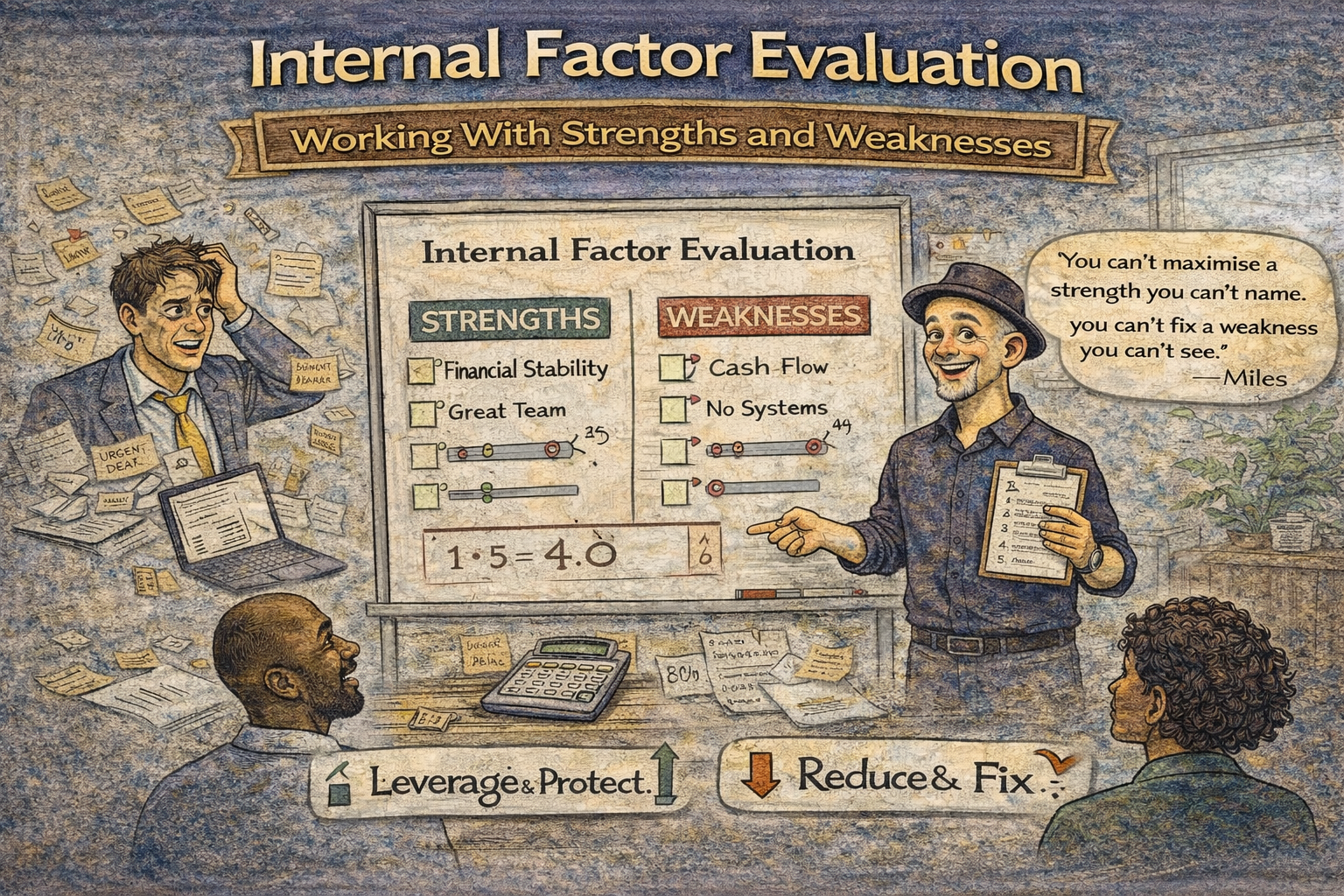
Internal Factor Evaluation Matrix for Busy Brains
From the outside, your business probably looks fine.
Website works.
Invoices go out.
Nobody is actively on fire.
Then you step inside.
Delegated tasks vanish into folklore.
Stock planning is a rumour.
Nobody can explain the strategy, but a few people seem to think it involves you buying a Porsche.
The place is held together by hope, WhatsApp, and 97-year-old Marge in accounts.
Then Marge falls down the stairs.
That is exactly why you need the Internal Factor Evaluation Matrix, or IFEM.
Not another corporate ritual.
Not a document you wave around while saying “operational excellence” with a dead expression.
A structured way to answer one brutal question:
Where are we actually strong, and where are we quietly weak?
Because a strategy built on wishful thinking is still wishful thinking. It just has a nicer template.
This piece follows the earlier parts of Simple Strategies for Busy Brains.
First, you defined a real outcome with T.A.R.G.E.T.S™.
Then you defined what winning means with Winning Statements.
Then you built a 3-year vision
Then you scanned the outside world with PESTEL.
In the last session, you identified the industry Key Success Factors
What on earth is IFEM?
The Internal Factor Evaluation Matrix is a strategic management tool for evaluating the key internal factors shaping your business. It helps you identify real strengths and real weaknesses, assign them quantitative value, and see which ones matter most to success or quietly block growth. That is the useful bit. It moves you from vague opinion into structured judgment.
In plain English:
It stops you from running the business on vibes.
Instead of saying:
“We’re quite good with clients”
or
“Operations is a bit messy but we’ll sort it out later”
you build a simple matrix.
You:
- identify your most important strengths and weaknesses
- assign each a weight based on strategic importance
- rate how you are actually performing
- calculate a weighted score
- total the matrix and see what kind of internal position you really have
That is a lot less glamorous than launching a new offer.
It is also vastly more useful.
Why busy brains avoid this
If you have a busy brain, this exercise can feel a bit itchy.
You would generally prefer:
- fresh ideas to internal audits
- momentum to measurement
- new projects to old weak spots
- exciting opportunities to the phrase “documented processes”
So you skim your own business like a social feed.
“Oh look, we’re great at relationships.”
“Oh look, profits are… somewhere.”
“Oh look, yes, operations is weird, but the real problem is probably marketing.”
No. Sometimes the real problem is exactly the boring thing you keep stepping over. I have been there.
That is why IFEM matters. It forces you to put strengths and weaknesses on the same page, measure them in a disciplined way, and stop pretending that “we’ll get to it” is a strategic doctrine. That bridge from analysis to action is one of the central points of the model.
Why this matters after PESTEL
There are a number of similarities between the previous KSF Triad exercise and the IFE. You use KSFs to see what has to be done to succeed in an industry. You use the IFE to see “what’s in the bag?” That is, if you have the ability to do it, what needs to be addressed in order to get going.
What’s in the Bag?
In addition, you may already have done an external scan like PESTEL or an EFE Matrix.
That tells you what is happening around you:
politics, economics, technology, social shifts, law, threats, opportunities.
IFEM tells you what is happening inside you:
team capability, systems, leadership, cash discipline, processes, customer retention, founder dependence, operational reliability.
Put simply:
PESTEL / EFE: What is the weather doing outside?
IFEM: Am I internally built for that weather, or am I hiking into a storm in flip flops and false confidence?
You need both.
Because one without the other is how you spot a great market opportunity, scale hard, and then discover that your internal systems were held together with chewing gum and Marge. Your IFEM can also be used alongside external analysis to support stronger competitive positioning, which is exactly how the model is meant to work.
How the IFEM actually works
Step 1: Identify your internal factors
List the key internal strengths and weaknesses that matter most to your business.
Examples of strengths:
- strong customer loyalty
- a stable capable team with relevant competencies.
- solid cash flow with money in the bank
- documented processes
- reliable delivery
- A strategic asset that is difficult to copy
Examples of weaknesses:
- poor stock management
- over-reliance on the founder
- slow response times
- weak innovation
- inconsistent marketing
- outdated systems
- Weak cash flow
Do not write twenty-seven items because your conscience got emotional.
Pick the factors that actually drive results.
Step 2: Assign weights
Each factor gets a weight from 0.00 to 1.00 based on how important it is to business success.
All the weights together must add up to 1.00. That is one of the core rules of the matrix. It forces you to show what matters most instead of treating everything like a national emergency.
Step 3: Rate performance
Each factor then gets a rating from 1 to 4:
- 1 = major weakness
- 2 = minor weakness
- 3 = minor strength
- 4 = major strength
This is not a measure of your wishful thinking, your hopes, your intentions, or what the team meant to do.
It is a measure of what is true today. If you are like me the that is a really tough exercise.
Step 4: Calculate weighted scores
Multiply the weight × rating for each factor.
If customer loyalty has a weight of 0.15 and a rating of 4, its weighted score is 0.60.
Do that for each factor, then add them all together.
Step 5: Interpret the total
A total above 2.5 usually suggests the business has more internal strengths than weaknesses. A score below 2.5 suggests the opposite. That does not mean the company is doomed. It means the building is wobblier than the website suggests.
Then comes the useful bit:
You look at the individual weighted scores and ask:
- where are we genuinely strong?
- where are we quietly weak?
- what deserves resources, fixing, protecting, or investing in?
That is where IFEM becomes a strategy.
The busy-brain version
Give it 30 minutes.
Not a retreat.
Not a week of fiddling with colour codes.
A fast, honest internal audit.
Do this:
- List your top strengths and weaknesses.
- Give each one a weight.
- Rate each honestly.
- Calculate the weighted scores.
- Highlight:
- your strongest real strengths
- your most dangerous weaknesses
- the factors that deserve action first
That is enough to give you a much cleaner view of where to allocate time, money, leadership attention, and operational energy. IFEM is especially useful for resource allocation, operational improvement, strategic alignment, and monitoring progress over time, rather than treating internal evaluation as a one-off event.
A better question
Old question:
“What’s wrong with this business?”
That usually leads to blame, fog, and somebody mentioning morale.
Better question:
“Which internal factors matter most, how strong or weak are we really, and what does the matrix say we should address first?”
That question is far less dramatic.
It is also how adults stop tripping over the same weakness for three years.
Closing
When you run a busy brain and a business at the same time, everything can feel urgent.
IFEM helps you separate:
- emotion from impact
- flattering stories from actual strengths
- recurring pain from minor irritation
- internal reality from entrepreneurial folklore
It does not exist to make you feel bad.
It exists to make you clear.
Because once you can see the real internal picture, you stop guessing what is wrong.
You stop blaming the economy for your filing system.
You stop calling founder dependence “leadership.”
And you can finally do what strategy is supposed to do:
Build from genuine strengths.
Fix dangerous weaknesses.
And stop asking poor Marge to hold the company together with a stapler and blood pressure tablets. She has had a rough day!