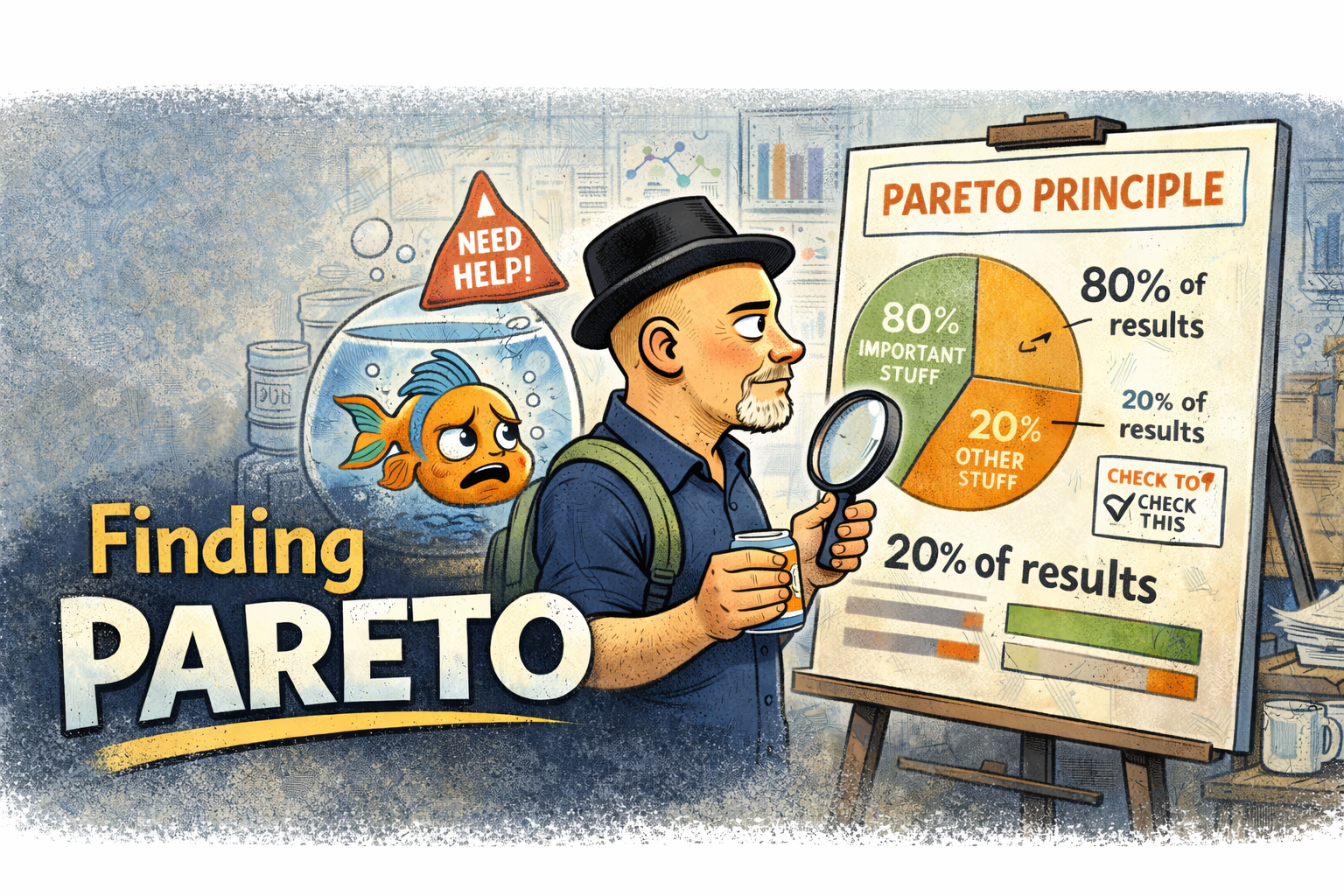
Forget about finding Nemo.
I’m looking for a different creature: Pareto.
Have you found it yet?
Have you even started looking?
Finding Pareto is very different to finding Nemo.
Finding Nemo was really easy.
Finding Pareto, and the promise of efficiency, wealth, health and happiness, took far longer.
Pareto is the idea that a small number of activities create most of your results.
Sometimes called the 80/20 Principle.
Why Pareto Matters to Busy-Brained, Distractible Humans
If you’re overwhelmed (despite the accusations) you’re probably not lazy.
You’re probably enthusiastic. Tragically so.
Busy-brained people love activity that feels productive:
- neat little rituals
- colour-coded lists
- “just checking” email (another hour of thinking)
- meetings about meetings (didn’t anyone keep minutes?)
- planning the plan to plan the launch
A lot of it was copied from the wrong people:
- old corporate bosses who measured doing, not results and outcomes
- “successful” friends whose lives are quietly on fire (most people have no idea why they’re successful, but they will happily explain it anyway)
- your own fuzzy definition of what actually matters (and what is just noise)
Some of us left corporate and accidentally rebuilt the same chaos in our own business.
Same calendar app. Different logo. Fewer results.
How did that happen? I could see EVERYTHING my previous company was doing wrong.
Busyness for the Sake of Business (Here Be Dragons)
Busyness is seductive because it gives you a simple emotional payoff:
“I did lots of stuff today.”
Shame it didn’t achieve anything.
Two common reasons:
- You never defined what “results” actually are.
- You never wrote down a strategy, so your to-do list became your strategy.
Busyness and productivity frequently do not go together.
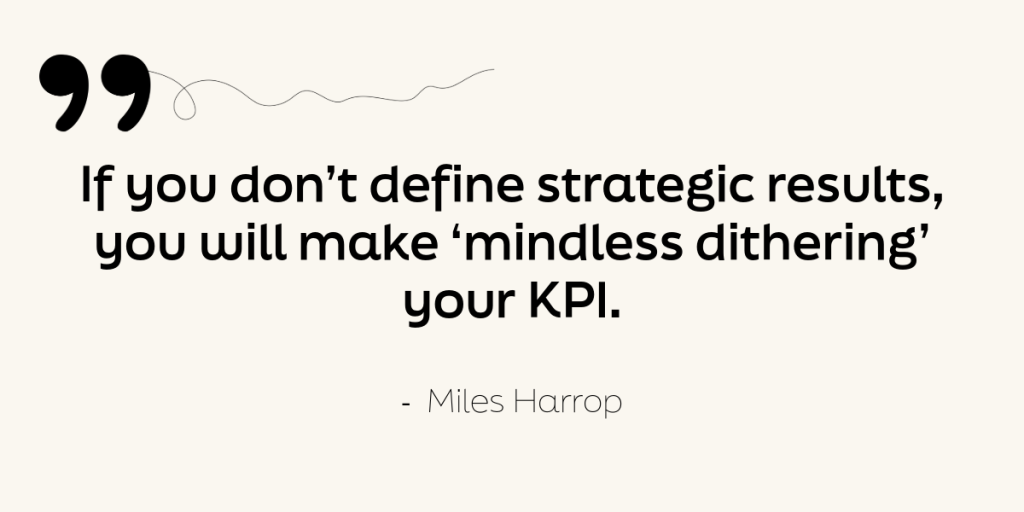
Sometimes busyness pips results.
Do the job. Fill in the report. Rinse. Repeat.
“Oh, look at the time! Time to retire already?”
So is there a quick technique or methodology that can help?
Pareto to the rescue.
So What Is This Pareto Thing?
Very short version:
- Not everything you do is equally important.
- A small slice of your actions is secretly carrying most of the load.
If you are busy-brained and distractible, this should make you raise one immaculately trimmed eyebrow and mutter words which are unmentionable in mixed company.
Because it means you could be dithering on the wrong 80%.
Corporates, Root Canals & Other Strange Hobbies
Large corporates are a different animal to us mere mortals.
Although some people claim that all small businesses should “corporatise”, there is only a partial and vague truth in that.
Some people genuinely enjoy the corporate setting.
Just as some people enjoy emergency root canals.
There are even people who become addicted to surgical procedures.
I recently read about a vascular surgeon who froze his own legs in order to have them amputated so he could claim from an insurance policy.
It must be true, because it was on the inter-web, and there were pictures.
These are not necessarily the people you should model your business systems on.

Systems, Toenails and Other Necessary Evils
Some systemising and repetitive process creation is necessary.
Even for the novelty-addicted among us.
Systems are like hygiene.
Boring, but your relationships will thank you.
For instance, cutting your toenails is not exciting.
The problems begin when you innovate for the sake of innovation.
When, instead of cutting your toenails every week, you decide to “optimise” toenail cutting… by cutting your toes off. No more toenail cutting. 10 minutes saved.
Then your accountant points out it is wasteful to do ten mini toe amputations.
You might as well cut your feet off.
A simple investment in titanium prosthetics and you can even save money on shoes.
What could possibly go wrong? In reality, it’s a crime against footwear.
It is clear that some companies take it too far.
So be wary when you try to copy a business model.
So What Are You Actually Looking For?
You are not looking for more things to do.
You’re looking for the few actions that actually shift the needle.
Which needle?
- revenue
- relationships
- retention
- reputation
- recovery (yes, recovery is a needle too)
Ask yourself:
- Where did your past success really come from?
- Which actions were directly connected to it?
- Are those actions aligned with the strategy you say you want now?
If not, you may be maintaining someone else’s 80% instead of building your own 20%.
The 10-Minute Pareto Sweep (Do This Today)
Let’s make this painfully practical.
1. The 3 “M”s of Monthly Core Processes
These are the Core Processes that actually move your strategic KPIs.
For me, they fall into three buckets:
- Money
Sales, proposals, pricing, invoicing. - Momentum
Creating assets, writing, content creation, improving delivery. - Meaning
Relationships, leadership, key conversations, research.
2. Put a Number on It
Attach a value to the revenue generated per hour for this activity.
If my monthly revenue is $5,000 and I spend 20 hours per month on these Core Processes, then my hourly income for Core Process time is $250.
That’s what this time is really worth.
Now:
- List the specific actions you did last month in Money, Momentum, Meaning.
- Circle the top 3 items that produced a real result.
Not “felt productive”.
A real result is normally defined in your strategy and shows up as a KPI.
Schedule those 3 things first next week.
Protect them like a terrier protects his supper.
That’s your first deliberate stab at your 20%.
Rinse. Repeat.
3. Non-Core Processes
Now list the other category:
- Maintenance
Admin, inbox, “keeping the lights on”.
In my case this includes admin, writing quotes, website tech, social media, accounting.
These are draining activities for me.
We’ve just defined how much these activities cost me.
That’s right: $250 per hour.
Now ask:
- Can I ship these out for less than that?
Of course I can. That’s the beginning of your delegation strategy. - Can I stop doing, or reduce the time I spend on these?
- Of course I can.
Finding Pareto on Purpose
So here we are again.
Forget Nemo.
Start looking for Pareto.
Not in a textbook.
In your calendar.
In your task list.
In the ten things you think you “have” to do today.
Somewhere in there is the tiny slice that actually matters.
The moment you stop copying corporate toenail rituals and start asking: